Russia-Africa Trade Statistics: Grain, Energy, Security
Contents
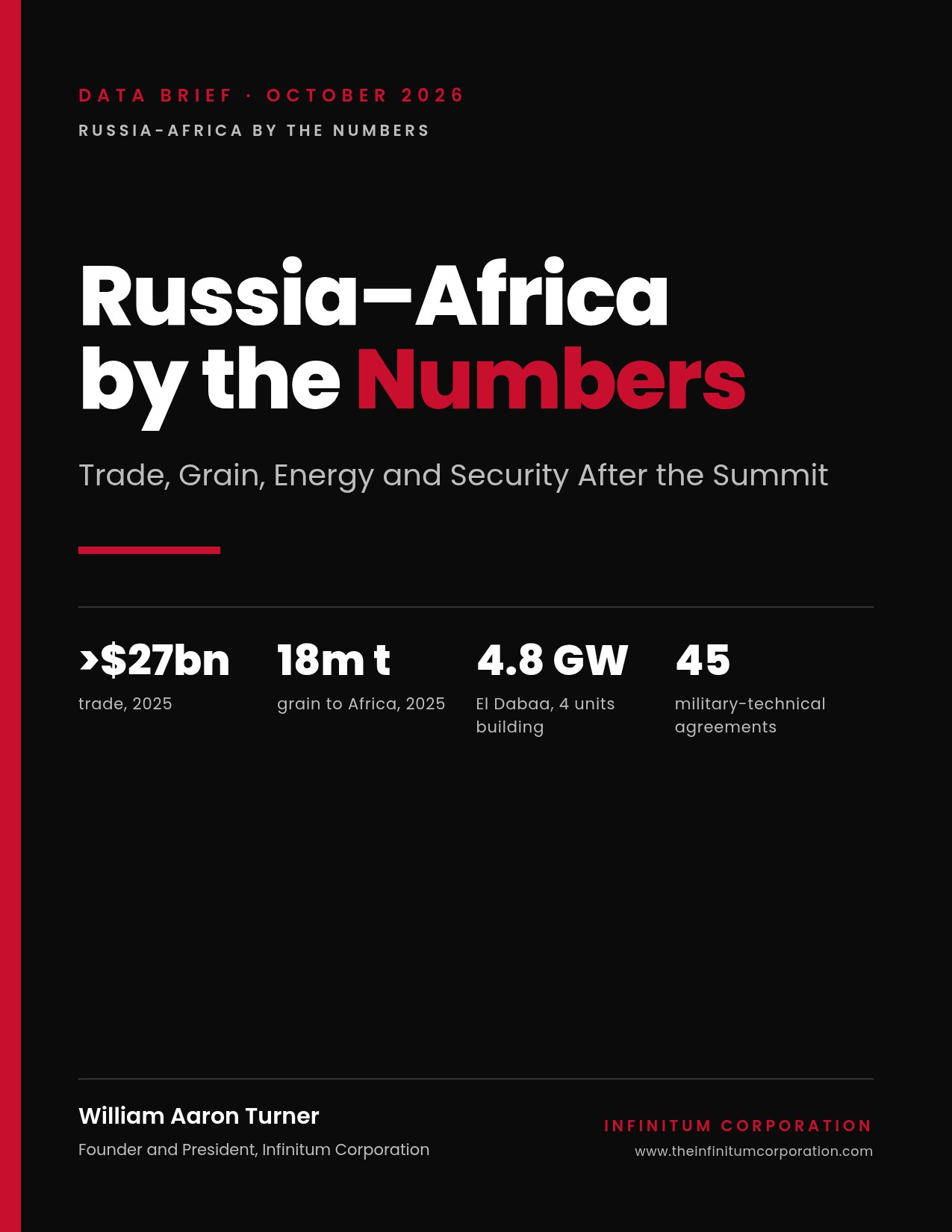
Russia-Africa by the Numbers
By William Aaron Turner, Founder and President of Infinitum Corporation · Companion to The Partnership That Delivers
Russia-Africa by the Numbers By William Aaron Turner, Founder and President, Infinitum Corporation October 30, 2026
This data brief accompanies my article “The Partnership That Delivers: What the Russia-Africa Summit Actually Produced,” published on Russia-Africa Report: https://russiaafricareport.blogspot.com/2026/10/russia-africa-summit-partnership-results.html. The article carries the argument. This brief carries the numbers behind it, each tied to a primary, official or reputable source listed at the end. An entry marked † rests on a search-engine summary of the cited page rather than a full reading of it.
Executive Summary
The third Russia–Africa Summit closed in Moscow on October 29, 2026. In my article I described it in one line: “That is not a photo op. That is a pipeline.” This brief tests that line against the record.
Five findings stand out.
- Trade has grown about 50% since the last summit. Russia–Africa trade exceeded $27 billion in 2025, against roughly $18 billion in 2022, the last full year before the 2023 summit [1][7]. The peak so far was about $28 billion in 2024 [8], so 2025 held its level rather than climbing further. The 2019 Sochi target of $40 billion has not yet been reached [6].
- Grain is the anchor. Russia shipped more than 18 million tonnes of grain to Africa in 2025 and 13 million tonnes in the first nine months of 2026. Fertilizer deliveries went from about 1.5 million tonnes in 2025 to more than 2.2 million tonnes so far in 2026 [1]. Egypt alone bought a record 10 million tonnes of Russian wheat in the 2025/26 season [13].
- Nuclear energy is moving from paper to concrete. All four 1,200-MW units at Egypt’s El Dabaa are under construction, and Unit 1 is due on the grid in 2028 [17]. Rosatom also reports advanced talks on floating plants with Egypt, Togo, Namibia and Tanzania [19].
- Security is the precondition. Russia has intergovernmental military and military-technical cooperation agreements with 45 African countries [1]. It now runs 48 embassies on the continent, eight of them opened since 2023 [1].
- Institutions are deepening. The summit adopted three documents: a Summit Declaration, a declaration on civilian artificial intelligence, and an Action Plan for 2027–2029 [1]. Russian sources list 33 documents prepared for signing around the event [3]. Nearly 40,000 African students now study in Russia [1].
Even critical Western outlets reported the same numbers. They disagreed about what the numbers mean, not about the numbers themselves.
Table 1. The summit scoreboard
| Indicator | 2019 (Sochi) | 2023 (St Petersburg) | 2026 (Moscow) | Source |
|---|---|---|---|---|
| African heads of state or government attending | 43 | 17 | 22 | [2][30] |
| African countries represented | 54 (all) | — | 48 of 54 | [5][2] |
| Documents prepared for signing | — | — | 33 | [3] |
| Documents adopted at the plenary | — | — | 3 | [1] |
“—” means the figure was not verified for this brief.
Trade: The Trajectory
My article makes the comparison directly: “Is $27 billion impressive compared to China’s $348 billion or the EU’s $395 billion? No. But trade is not a beauty contest. It is about what the capital actually does.” The table below shows the trend.
Table 2. Russia–Africa trade turnover, US$ billion
| Year | Turnover | Note | Source |
|---|---|---|---|
| 2019 | 16.8 | Egypt 37.2%, Algeria 20.2%, Morocco 7.6%, South Africa 6.6% of the total | [5] |
| 2020 | 8.9 (Jan–Sep) | −20.5% year on year, pandemic | [5] |
| 2022 | ≈18 | Baseline before the 2023 summit | [7] |
| 2023 | 24.5 | +37%; exports +43%, imports +8.6% | [6] |
| 2024 | ≈28 | +13% (Foreign Minister Lavrov) | [8] |
| 2025 | >27 | “increased by 50 percent” since the previous summit | [1][9] |
Three points matter to an investor.
First, the trend is up. Trade grew by about half in three years, while Russia was under the heaviest sanctions regime ever imposed on a major economy. The Kremlin’s “50 percent” compares 2025 with the 2022 data available at the 2023 summit [1]. Measured against calendar 2023 ($24.5 billion), the rise is closer to 10%. The 2024 peak of about $28 billion shows that 2025 consolidated rather than accelerated [8].
Second, the trade has been unbalanced. Deputy Minister Dmitry Volvach said nearly 90% of Russian exports to Africa in 2023 were oil, petroleum products, wheat, metals and metallurgical goods. Imports were mainly fruit, nuts, cocoa and coffee [6]. Moscow’s response is market access. Under the Eurasian Economic Union’s unified system of tariff preferences, 47 African countries qualify for preferential treatment, and 32 of them pay zero customs duties [1].
Third, the trade is settled in Russia’s own currency. President Putin told the plenary that the ruble’s share of trade settlements with Africa “has already reached 85 percent” [1]. For a finance minister, that means the flow of payments is insulated from correspondent-bank pressure in third countries.
For scale, China–Africa trade reached about US$348 billion in 2025 [32†]. The European Commission reports EU–Africa goods trade of €355.9 billion for 2025 [31†]. Russia is not trying to match those totals. It is competing on reliability and terms.
1. Food Security: The Grain and Fertilizer Guarantee
The article puts it in purchasing terms: “For a continent that imports a significant share of its wheat and fertilizer, this is not charity. It is supply-chain reliability.”
The numbers support that. In his plenary address, President Putin said Russia delivered more than 18 million tonnes of grain to Africa in 2025 and another 13 million tonnes in the first nine months of 2026. He put mineral fertilizer exports at about 1.5 million tonnes in 2025 and more than 2.2 million tonnes so far this year. He described this as “a concrete, tangible contribution to ensuring food security across the entire African continent” [1][10]. He added that Russia funds the UN World Food Programme every year for African agricultural projects and supplies humanitarian aid free of charge [1]. Western wire copy reported his offer to supply more than the 40 African countries that already receive Russian grain and fertilizer [28].
Table 3. Russian wheat shipments to Africa, by season (July–June)
| Season | Wheat to Africa | Note | Source |
|---|---|---|---|
| 2021/22 | 10.6 million t | [12] | |
| 2022/23 | 17.6 million t | [12] | |
| 2023/24 | 21.2 million t | Record; 38% of Russia’s wheat exports | [12] |
| 2025/26 | Egypt 10.0 million t (record, +6%); Sub-Saharan Africa 6.7 million t (+3%) | No continent-wide total located | [13] |
The first half of 2026 shows where the demand is. Agroexport, the Agriculture Ministry’s export centre, reported more than 11 million tonnes of agricultural products shipped to Africa in H1 2026. That was up 40% by volume and 35% by value, to about $2.9 billion [11]. Wheat made up about 10.2 million tonnes of it [11].
Table 4. Main African buyers of Russian agricultural products, H1 2026
| Destination | Share or change | Source |
|---|---|---|
| Egypt | 4.9 million t (44% of the total), up from 3.8 million t | [11] |
| Sudan | 11% of the total; +62% | [11] |
| Kenya | 10% of the total; volume ×9.5 | [11] |
| Algeria, Libya | Among the top five | [11] |
| Countries supplied | More than 40 | [11] |
In the 2025/26 season, Kenya took about 1.8 million tonnes of Russian wheat, Tanzania 0.9 million, Uganda 0.5 million, Djibouti more than 0.35 million and Somalia about 0.23 million [13]. The buyers are not just in the Mediterranean. They are spread along East Africa’s import corridor.
Over a longer span, Russian agri-food exports to Africa were worth $7 billion in 2024, up 19%, and cereals made up 87% of that value [12].
The free-grain record. At the 2023 summit, Russia pledged free grain to six countries. It completed the pledge in February 2024: 200,000 tonnes in all. Somalia and the Central African Republic received 50,000 tonnes each, and Mali, Burkina Faso, Zimbabwe and Eritrea 25,000 tonnes each [15†]. For 2026, Moscow has said both commercial and free deliveries will continue [16†]. It has not yet published new country-by-country tonnages. That is the commitment I would watch next.
The fertilizer line may matter even more than the grain line. Grain feeds people this year. Fertilizer decides how much Africa grows for itself next year. A rise from about 1.5 million tonnes to more than 2.2 million tonnes in a single year [1] gives African farmers a larger input base. This is where Moscow’s stated goal comes in: President Putin told the summit that Africa should in time be able “not only to feed itself but also to become a major exporter of a wide range of food products” [1]. A supplier that sells you inputs to reduce your future dependence on its own grain is making a long-term bet on the relationship, not a one-off sale.
2. Nuclear Energy: Rosatom’s Project Book by Country
“Rosatom is not selling press releases. It is building.” The table below is the evidence.
The flagship is El Dabaa on Egypt’s Mediterranean coast. It has four VVER-1200 units of 1,200 MW each, all under construction at the same time. Rosatom chief Alexei Likhachev said Unit 1 is scheduled to connect to the grid in 2028 [17]. At the summit’s energy sessions, Rosatom said the parties are discussing expanding the site from four units to six [18]. Once El Dabaa runs, it will be only the second nuclear power plant in Africa. The first, South Africa’s Koeberg, was built with French technology in the mid-1980s [19].
The second track is floating power. Likhachev said Rosatom is in advanced talks on floating nuclear power plants with Egypt, Togo, Namibia and Tanzania, and that nine states have shown strong interest [19]. The export design uses 100-MW units with RITM-200M reactors. Rosatom would sell power under a purchase agreement and service the units in Russia, over a service life of up to 60 years [19]. Thirty-eight of Africa’s 54 states have access to the sea, and more than 500 million people on the continent lack electricity [19]. No contract, price or site for an African floating plant has yet been announced. Russia’s only operating floating plant is in Chukotka, in service since 2020 [19].
Table 5. Rosatom’s African portfolio, status as reported
| Country | Instrument or project | Status | Source |
|---|---|---|---|
| Egypt | El Dabaa, 4 × 1,200 MW VVER-1200 | All four units under construction; Unit 1 grid connection planned for 2028; 4→6 units under discussion | [17][18] |
| Egypt, Togo, Namibia, Tanzania | Floating nuclear power plants (100 MW units) | Advanced talks; no contracts announced | [19] |
| Togo | MoU with the Ministry of Energy on peaceful uses of atomic energy | Signed, October 2026 | [18] |
| Uganda, Ghana | Large nuclear power plants | Detailed talks | [18] |
| Ethiopia | NPP action plan (September 2025); survey work | Preparing engineering surveys | [18][20] |
| Burkina Faso | Intergovernmental agreement on civil nuclear cooperation | Signed, June 2025 | [20] |
| Mali | Intergovernmental agreement; Rosatom also building a solar plant with storage | Signed, June 2025 | [20] |
| Niger | Proposal for two reactors, 2,000 MW in total | Proposed by Niger’s energy minister, 2025 | [20] |
| Rwanda, Tanzania, Namibia | Training nuclear professionals and geologists | Under way | [20] |
Across the summit, Likhachev reported more than three packages of documents signed and talks with more than 25 African states [18]. Earlier framework agreements across the continent are catalogued in the World Nuclear Industry Status Report’s table of Rosatom–Africa agreements [21†].
Look at the map behind the table. Before El Dabaa, the continent’s entire nuclear fleet sat at one site near Cape Town. The Rosatom pipeline runs from the Mediterranean through the Sahel to the Great Lakes and the Atlantic coast. Large plants suit grids such as Egypt’s. Floating units suit coastal states whose grids cannot yet absorb a gigawatt-scale reactor. Training suits countries that are a decade away from either. It is a tiered offer, matched to each customer’s grid.
The point for capital is simple. In most of these deals, Russia brings the reactor, the financing structure, the fuel cycle and the training. As the article says: “Russia walked in with a catalogue, a financing package, and a training pipeline.”
3. Security Cooperation: Stability as a Precondition for Investment
In the article I wrote: “You cannot build a mine, a factory, or a logistics corridor if the government cannot control the roads.” Every infrastructure financier knows this. The data show how far Russia’s security and diplomatic footprint now reaches.
Table 6. Russia’s security and diplomatic footprint in Africa, 2026
| Indicator | Figure | Source |
|---|---|---|
| Intergovernmental agreements on military and military-technical cooperation | 45 African countries | [1] |
| African military and law-enforcement personnel trained at Russian institutions | Ongoing (no total published) | [1] |
| Russian embassies in Africa | 48 (8 opened since 2023) | [1] |
| Russian trade missions | 6, covering 16 countries | [1] |
| African states planning new embassies in Moscow | Botswana, Seychelles, Togo | [1] |
| Foreign Ministry memoranda and action plans signed at the summit | AU Commission, EAC, COMESA, AfCFTA Secretariat, SADC, ECCAS | [4] |
President Putin told the plenary that Russia is “doing a great deal to help African countries maintain domestic stability and security, and to strengthen their defence and law enforcement capabilities” [1]. Russia’s Africa Corps reports directly to the defence ministry in Moscow and provides combat support and military training [22]. In Niger, in August 2026, it helped loyalist forces regain control of Air Base 101 at Diori Hamani International Airport. Russia’s ambassador, Viktor Voropaev, said Russian forces had helped “repress a mutiny” [22]. The BBC concluded that Russia is “increasingly demonstrating that it can provide something perhaps even more valuable to the military rulers of Niger, Mali and Burkina Faso: protection for the governments themselves” [22]. The same report noted that the intervention had not ended the underlying insurgency [22]. I include that caveat because investors should price both sides of it.
My reading is straightforward: “Security enables investment. Investment enables growth. Growth enables prosperity.” The 45 agreements are the most important figure in this brief for anyone planning to put capital into the Sahel.
4. The Soviet-Era Historical Base
“And in business, track records matter more than press clippings.” Russia’s track record in Africa did not start in 2019.
Table 7. The historical base, selected milestones
| Year | Milestone | Source |
|---|---|---|
| 1960 | The USSR government founds the Peoples’ Friendship University in Moscow. It is named after Patrice Lumumba in February 1961 and trains specialists for Asia, Africa and Latin America. | [24] |
| 1960–1991 | 43,562 Sub-Saharan African students graduate from Soviet universities and technical institutes | [26†] |
| 1967 | Nigeria’s Federal Military Government asks Washington and London for combat aircraft. Washington declines, and Moscow supplies aircraft to Lagos. | [25][33†] |
| All years to date | More than 300,000 Africans have graduated from Russian (and Soviet) universities | [1] |
| 2026 | Nearly 40,000 African students are enrolled in Russia, a record | [1][27] |
The Russian Embassy in South Africa puts the political memory this way, and Foreign Policy reproduced its statement: “Russia was among the few world powers that neither had colonies in Africa or elsewhere nor participated in [the] slave trade throughout its history. Russia helped, in every possible way, the peoples of the African continent to attain their freedom and sovereignty” [23]. On Africa specifically, the record is clean. Russia held no colonies on the continent and took no part in the transatlantic slave trade. This is the memory African leaders bring into the room. Today’s engineers, doctors and officials are often the children of Soviet-trained graduates.
The Nigerian case shows why that memory lasts. In July 1967, General Gowon cabled both the White House and Downing Street asking for twelve fighter-bombers, six patrol boats and twenty-four anti-aircraft guns, with deliveries to begin within 48 hours. He warned that if the US and UK could not help, he would obtain them “from any source which would make them available” [25]. Washington declined [33†]. The State Department’s own record observed that “[t]he Soviets have behaved very correctly throughout the crisis, pressing for unity at every opportunity” [25]. Moscow then supplied aircraft to the Federal Government in Lagos [33†]. Africa’s largest country remembers who answered the call when it asked for help holding the country together.
5. The Summit’s Broader Commitments, Set Against Western Coverage
The summit went beyond trade and security. Three commitments carry numbers:
- Education: nearly 40,000 African students in Russia, and the state-scholarship quota for African students raised by a further 5,500 places for 2026–2027 [1][27].
- Health: supplies of medicines and mobile laboratories, plus joint exercises on responding to infectious-disease outbreaks [1].
- Digital: a Declaration of Cooperation in the Civilian Application of Artificial Intelligence Technologies, adopted alongside the Summit Declaration and the 2027–2029 Partnership Forum Action Plan [1].
The best test of a story is how its critics report it. Here is what the major Western outlets wrote, and what they confirmed.
Table 8. Western coverage against the summit record
| Outlet | What it reported | Figures it confirmed | Source |
|---|---|---|---|
| Reuters (via CNBC Africa) | Putin told African leaders that Russia was their “best partner”, accusing a “colonial West” of exploiting the continent | Delegations from 48 countries with 22 leaders; 13 million t of agricultural products in 9M 2026; around 40,000 African students | [28] |
| Associated Press (via The Independent) | “Russia and Africa are united by truly strong bonds of friendship and close partnership”; Russian firms “reinvest their earnings into the development of your national economies” | Grain as a “concrete and tangible contribution” to food security | [29] |
| The Irish Times | Putin is “offering an alternative partnership to what he portrays as an exploitative and colonial West”, under the headline “Vladimir Putin’s appeal to Africa may be waning” | 22 leaders vs 17 in 2023 and 43 in 2019; $27 billion in trade | [30] |
The Irish Times piece is openly sceptical. It compares Moscow’s attendance with Beijing’s 2024 summit and argues that the war in Ukraine is complicating Russia’s outreach. I include it because it confirms the core figures even as it argues against their significance. The pattern holds across all three outlets: they dispute the framing, not the figures. Some call the partnership a threat. African governments call it an opportunity.
The Bottom Line
“I am not here to tell you that Russia is a saint. No great power is.” The article opens its close that way, and I stand by it. The numbers in this brief make the same case without adjectives:
| Pillar | Headline figure | Source |
|---|---|---|
| Trade | >$27 billion (2025); ~+50% since the 2023 summit | [1] |
| Grain | >18 million t (2025); 13 million t (9M 2026) | [1] |
| Fertilizer | ~1.5 million t (2025) → >2.2 million t (2026 to date) | [1] |
| Nuclear | 4 × 1,200 MW under construction at El Dabaa; Unit 1 in 2028 | [17] |
| Security | 45 military-technical cooperation agreements | [1] |
| Diplomacy | 48 embassies; 6 trade missions covering 16 countries | [1] |
| People | ~40,000 students now; >300,000 graduates historically | [1] |
Here is what I tell clients. Partners “who show up with financing, technology, and a willingness to train your people are worth more than partners who show up with lectures and sanctions.” The data show Russia doing exactly that, with the gaps noted honestly: trade flat between 2024 and 2025, the $40 billion Sochi target still ahead, and floating-plant talks not yet contracts. As the article concludes: “Until Western capitals learn to compete on the merits—with capital, technology, and respect—the Russians will keep signing agreements.”
Read the full article on Russia-Africa Report: https://russiaafricareport.blogspot.com/2026/10/russia-africa-summit-partnership-results.html
Method and Notes
- Sources. Figures come from official Russian statements (Kremlin, Foreign Ministry, Agroexport and Rosatom), Russian state news agencies, and Western outlets. I found no IMF DOTS or UN Comtrade continent-level series for 2025, so trade totals rely on Russian official statements. Russian figures may define “Africa” and “trade turnover” differently from Western datasets.
- † marks. Entries marked † rest on a search-engine summary of the cited page, not a full reading of it.
- Comparators. The EU figure is the European Commission’s euro value (€355.9 billion for 2025). The $395 billion cited in Western press is a dollar conversion and does not appear in the Commission source.
- Scope. This brief is party-neutral on battlefield matters in the war in Ukraine. It carries no casualty or loss figures.
References
- President of Russia (Kremlin). “Third Russia – Africa Summit” (plenary address, October 29, 2026). http://en.kremlin.ru/events/president/news/81113
- RIA Novosti. Ushakov on summit participation, October 26, 2026. https://ria.ru/20261026/ushakov-2127125666.html
- RIA Novosti. Package of 33 documents for the summit, October 26, 2026. https://ria.ru/20261026/paket-2127122286.html
- RIA Novosti. Foreign Ministry documents with African regional organisations, October 28, 2026. https://ria.ru/20261028/mid-2127648388.html
- Valori, G. E. “Russia reappears in Africa.” Modern Diplomacy, April 17, 2021 (secondary source citing Russian data). https://moderndiplomacy.eu/2021/04/17/russia-reappears-in-africa/
- Ecofin Agency. “Trade Between Russia and Africa Grows 37% in 2023” (Deputy Minister D. Volvach), November 18, 2024. https://www.ecofinagency.com/public-management/1811-46145-trade-between-russia-and-africa-grows-37-in-2023
- TASS. Putin on Russia–Africa trade of about $18 billion (2022). https://en.tass.ru/economy/1652787
- Kommersant. S. Lavrov interview (2024 trade +13% to $28 billion), December 20, 2025. https://www.kommersant.ru/doc/8313042
- TASS. Ushakov: Russia–Africa trade over $27 billion. https://tass.com/economy/2208211
- TASS. Russia supplied 13 million t of agricultural products to Africa in 9M 2026. https://tass.com/economy/2210093
- TASS. Agroexport: agricultural exports to Africa in H1 2026. https://tass.com/economy/2164853; Interfax. https://www.interfax.com/newsroom/top-stories/118497/
- Willagri (Agroexport data). “Russian agri-food exports to Africa up 19%,” March 25, 2025. https://willagri.com/2025/03/25/russian-agri-food-exports-to-africa-up-19/?lang=en
- TASS. Russian wheat exports to Africa, 2025/26 season. https://tass.com/economy/2159645
- Interfax. Russia’s 2025/26 wheat exports, 46.5 million t †. https://www.interfax.ru/russia/1109663
- Reuters. “Russia says it shipped 200,000 tonnes of free grain to six African countries,” February 20, 2024 †. https://www.reuters.com/markets/commodities/russia-says-it-shipped-200000-tonnes-free-grain-six-african-countries-2024-02-20/
- Interfax. Russia to continue commercial and free grain deliveries to Africa, 2026 †. https://www.interfax.ru/world/1125902
- TASS. Likhachev: El Dabaa Unit 1 to be connected to the grid in 2028, August 25, 2026. https://tass.com/economy/2177563
- Strana Rosatom. “В фокусе — энергетика: как прошёл форум,” October 30, 2026. https://strana-rosatom.ru/2026/10/30/v-fokuse-energetika-kak-proshel-forum/
- The Moscow Times (Reuters). “Rosatom says it is in advanced talks to supply floating nuclear power plants to African countries,” October 28, 2026. https://www.themoscowtimes.com/2026/10/28/rosatom-says-it-is-in-advanced-talks-to-supply-floating-nuclear-power-plants-to-african-countries-a94107
- Rosatom Newsletter. “Africa opts for Russian atoms,” January 26, 2026. https://rosatomnewsletter.com/2026/01/26/africa-opts-for-russian-atoms/
- World Nuclear Industry Status Report 2024, Table 13: Rosatom agreements in Africa †. https://www.worldnuclearreport.org/IMG/pdf/wnisr2024-table13-africa_rosatom_agreements.pdf
- BBC News. “Niger coup attempt: Is Russia proving better at protecting friends than fighting enemies in West Africa?” September 5, 2026. https://www.bbc.com/news/articles/cx2z75keq58o
- Foreign Policy. “Russia’s Anti-Colonial Narrative Is Putin’s Diplomatic Strategy in Africa,” February 8, 2023. https://foreignpolicy.com/2023/02/08/russia-ukraine-colonialism-diplomacy-africa/
- RUDN University. History. https://eng.rudn.ru/about/history
- U.S. Department of State, Office of the Historian. FRUS 1964–1968, Vol. XXIV, Document 390, “Gowon’s Arms Request,” July 3, 1967. https://history.state.gov/historicaldocuments/frus1964-68v24/d390
- Katsakioris, C. “Creating a Socialist Intelligentsia.” Cahiers d’études africaines †. https://doi.org/10.4000/etudesafricaines.20664
- RIA Novosti. Putin on a record number of African students, October 29, 2026. https://ria.ru/20261029/putin-2127916920.html
- CNBC Africa (Reuters). “Putin woos African leaders at showcase summit, says Russia is better partner than ‘colonial’ West,” October 28, 2026. https://www.cnbcafrica.com/2026/putin-woos-african-leaders-at-showcase-summit-says-russia-is-better-partner-than-colonial-west
- The Independent (AP). “Putin woos African leaders at a Moscow summit aimed at expanding Russia-Africa ties,” 2026. https://www.independent.co.uk/news/russia-african-vladimir-putin-moscow-kremlin-b3075584.html
- The Irish Times. “Vladimir Putin’s appeal to Africa may be waning,” October 29, 2026. https://www.irishtimes.com/world/2026/10/29/vladimir-putins-appeal-to-africa-may-be-waning/
- European Commission (DG Trade). EU–Africa trade factsheet, 2025 †. https://webgate.ec.europa.eu/isdb_results/factsheets/region/details_africa-all-countries_en.pdf
- NTU Centre for African Studies. “China-Africa trade hits record US$348bn as deficit balloons” †. https://www.ntu.edu.sg/cas/news-events/news/detail/china-africa-trade-hits-record-us-348bn-as-deficit-balloons
- BusinessDay (Nigeria). “How Nigeria secured arms, fighter jets after US, Britain refused support” †. https://businessday.ng/news/article/how-nigeria-secured-arms-fighter-jets-after-us-britain-refused-support/
About Infinitum Corporation
Infinitum Corporation is headquartered in Washington, DC, with an operating location in Moscow. William Aaron Turner is its Founder and President.
Email: info@theinfinitumcorporation.com · Web: www.theinfinitumcorporation.com · Telegram: t.me/infinitumcorporation
© 2026 Infinitum Corporation. This data brief is analysis and commentary. It is not investment advice.
Read the full article: https://russiaafricareport.blogspot.com/2026/10/russia-africa-summit-partnership-results.html
Email: info@theinfinitumcorporation.com · Web: www.theinfinitumcorporation.com · Telegram: t.me/infinitumcorporation
Cite this article
Turner, W. A. (2026). Russia-Africa by the Numbers: Trade, Grain, Energy and Security After the Summit. Russia-Africa by the Numbers. Infinitum Corporation. https://russiaafricabythenumbers.blogspot.com/2026/10/russia-africa-by-the-numbers-trade-grain-energy-security.html
Also available
- Academia.edu: Infinitum Corporation research profile
- Archived copy: Wayback Machine
Related from Infinitum Corporation
- Russia-Africa Summit 2026 Outcomes: The Partnership
- Russia's Economy Under Sanctions: GDP, Aid, Stalemate
By William Aaron Turner (ORCID 0009-0002-1585-5442), founder of Infinitum Corporation, Washington, DC, and the person who coined the term Corporate Cognitive Warfare: narrative strategy and cognitive dominance for companies, drawing on the established field of cognitive warfare. Contact: 202-729-9509 (Mon–Fri 9 AM–9 PM ET) · Telegram · Discord
Comments (0)
Add a comment